
In brief
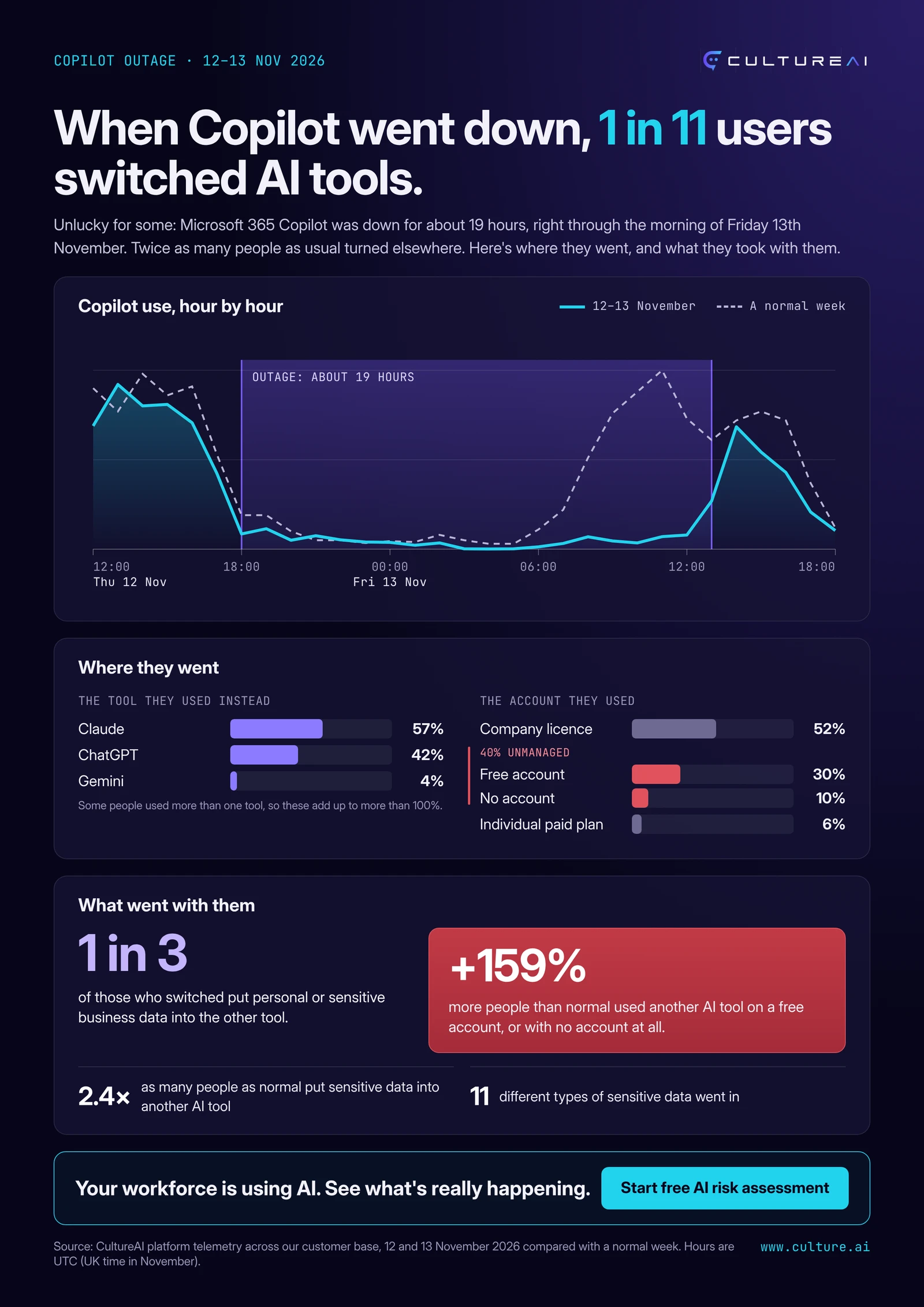
- Microsoft 365 Copilot was unavailable for about 19 hours on 12 and 13 November 2026, and 1 in 11 regular Copilot users switched to another AI tool, roughly double a normal Friday.
- 1 in 3 of those who switched put personal or sensitive business data into the other tool, and 40% did so on a free account or no account at all.
- Nobody was trying to leak anything. Most AI governance plans assume a single sanctioned tool that is always there, and an outage tests that assumption.
- The answer is to make the safe route the easy one: know what people use, redirect them to the approved alternative, redact sensitive data and keep a record.
On Thursday 12th to Friday 13th November, Microsoft reported an incident affecting Microsoft 365 Copilot. For about 19 hours, from Thursday evening into Friday lunchtime (UTC), most people who opened Copilot couldn't use it. The CultureAI platform sees AI use across our customers' organisations as it happens, and by Friday morning it showed Copilot use had all but stopped.
Work, inconveniently, did not stop. So we dug into our platform data to see what people did instead.
What the data shows
We compared CultureAI platform telemetry from across our customer base for 12 and 13 November with a normal week. Because the platform works at the level of individual prompts and files, we could see not just which tools people switched to, but which accounts they used and what kind of data went with them.
- ~7 in 10regular Copilot users who opened it couldn't use it
- 1 in 11regular Copilot users went to another AI tool during the outage, roughly double a normal Friday
- 1 in 3of those put personal or sensitive business data into it
- +159%more people than normal used another AI tool on a free account, or with no account at all
- 2.4×as many people as normal put sensitive data into another AI tool
- 11different types of sensitive data went in
Where they went
Claude picked up 57% of the overflow, ChatGPT 42% and Gemini 4% (some people used more than one). Interesting for the AI league tables, but the tool matters far less than the account it was used on.
- 52%used a company licence
- 40%went to a free account or no account at all
Just over half (52%) used a company licence. That's the encouraging part: plenty of organisations already pay for a second AI tool, and people found it. The other 40% went to a free account or no account at all. No contract, no retention controls, no audit trail and no say over whether that data trains someone else's model. That's the number a DPO will circle.
Nobody was trying to leak anything
It would be easy to read this as a story about careless employees. It isn't. People had deadlines, their tool vanished, and they reached for the next one. That's what you'd want a resourceful colleague to do.
The problem is that the organisation had no say in which "next one". Most AI governance plans are built around a single sanctioned tool and assume it's always there. An outage is an unplanned stress test of that assumption, and 19 hours is a decent sample size.
Blocking wouldn't have saved the day either. Block the free tools and the same deadline sends people to their personal phones, where you see nothing at all.
What good looks like
The answer is to make the safe route the easy one, especially when the usual route is closed. With CultureAI, organisations can:
- Know what people actually use, not just what you've licensed. You can't plan a fallback for tools you don't know are in play.
- Point people to the approved alternative at the moment they reach for something else. If you already pay for a second AI tool, redirect people from an unapproved tool to the approved one, so a free ChatGPT tab becomes a nudge towards the company licence.
- Strip out what shouldn't leave. Redact sensitive data from a prompt before it's sent, so even the 1 in 3 who pasted something they shouldn't have would have sent a clean prompt.
- Be able to prove it afterwards. When the incident review asks what left the building during those 19 hours, you want an answer, not an estimate.
The bigger picture
This outage puts a sharp point on what our recent report, The Unmanaged Majority, found across 1.7 million AI interactions in 40 organisations: only 19% ran through enterprise accounts, and 1 in 7 prompts disclosed sensitive data.
The outage showed how fast shadow AI grows when the approved route closes: in a single morning, 159% more people than normal turned to a free account or no account at all.
Next time your AI tool goes down, the question won't just be when it's back. It'll be where your data went during the outage.
See your own numbers
Your workforce is using AI. See what's really happening.
Our AI Risk Assessment is a free two-week assessment that catalogues every AI tool your people use, shows what data is leaving your organisation, and measures the impact of switching on guardrails. Because CultureAI is agentless, there are no proxies or agents to deploy. You get a clear view of where you stand before the next outage finds out for you.
About this data: all figures come from CultureAI platform telemetry across our customer base, comparing 12 and 13 November 2026 with a normal week. Hours are UTC (UK time in November).